Monday, October 29, 2007

The chimichanga debate

I have managed to write quite a few blogs without mentioning food, but now the time has finally come. When it comes to great Mexican food, Tucson has everything one could wish for: authentic Mexican, Tex-Mex, Arizona-Sonoran, national Mexican food chains and basically everything in-between. But what makes Tucson even more special is one menu choice in particular: the chimichanga.

Tucson likes to claim this delicious fried-burrito sensation originated within her lovely desert valley. In fact, as I did some quick research, I found debates about various myths explaining how it came about.

Wikipedia, for example, states in the first sentence of the chimichaga entry that it hails from the Old Pueblo; but the final sentence of the entry mentions a Phoenix restaurant owner may have come up with the dish.

The most common story I found, after looking at several sources, was that a burrito was accidentally dropped into a deep-fryer at El Charro Cafe (an historic Tucson restaurant dating back to 1922) by founder Monica Flin. As she was about to say a curse-word in Spanish she quickly changed her utterance to "chimichanga" (translates roughly to "thingamajig") to gaurd the ears of little ones in the kitchen with her.

Other sources seem a bit more realistic (in my opinion anyhow) about the debate, and say although the chimichanga gained it's popularity in Tucson restaurants, it was most likely being cooked before the 1920's along the border in Sonora, Mexico, where wheat and beef are harvested (info from findarticles.com.)
Whether or not Tucson is truly the origin of the chimichanga, I think we can all agree that finding a tasty fried-burrito in the beautiful Old Pueblo is pretty easy. But if you want to enjoy the meal at it's possible birthplace - El Charro Cafe - you will be in for a savory treat!
There is also the option of making your own, which I have not yet ventured to do. However, I am a proponent of the Food Network Web site, and they have a few different recipes for a delicious chimichanga. My favorite chef happens to be Emeril Lagasse, so try his version of a pork chimi, and let me know what you think!!
And if you think you've heard enough about chimichangas, think again. I found a 2006 story from a Sacramento news station about a woman who claims to have seen the face of Jesus Christ on her chimichanga. Please read the article and watch the video...am I allowed to say it's hilarious? Well, since it's my blog, I will.
Happy chimichanga eating!!

Sugar Skulls

Sugar skulls have become a traditional part of the Day of the Dead celebration. The skulls are most often created as a gift for a deceased relative or friend. They are a common sight at most Day of the Dead altars, and are brought to grave sites as well. The tradition is very important to strict observers of the holiday, and has also become a fun craft for children. Tucson has adopted this tradition, and sugar skulls have become a staple of the Tucson Meet Yourself celebration every fall. (Left: My dad, Larry Taylor, with a sign explaining Tucson Meet Yourself)
The pictures below are of children at Tucson Meet Yourself creating their own sugar skulls, and learning about the special Mexican tradition.
The skulls at Tucson Meet Yourself were pre-made because they take 24 hours to harden and dry. These childen began the process with adding the frosting, which is what the young boy to the left is about to do. The little girl to the right is recording her name as she prepares to decorate her sugar skull.
The skulls are made from a mixture of granulated sugar, meringue powder and water, and are placed in a mold to get their shape.
After adding frosting, which is a mixture of powdered sugar, meringue powder and water, the children added other decorations to make their skulls unique. These kids used feathers and glitter to create their own special sugar skull.
Traditional Mexican sugar skulls are decorated with foil and colored icing, and bear the name of the deceased loved one. However, children (or adults - whoever is making the skull) can add a variety of decorations to their skull such as beads, sequins or shells. Anything can be used to personalize the skull for the one it is being made for.
For a more detailed "how-to" about making sugar skulls, click here.

Sunday, October 7, 2007

Dia De Los Muertos - Tucson Style

Last year I attended the All Soul's Procession in downtown Tucson, watching as thousands of Southern Arizonan's came to celebrate the Day of the Dead. The Day of the Dead is traditionally a Mexican holiday, occuring after Halloween, that celebrates the death of family members. Tucson celebrates the holiday with a weekend of festivities, culminating in the incredible processionaly downtown.

I have to admit that attending the parade was not my idea (it was a class assignment). However, it turned out to be such an incredibly fun night, and I was amazed by a lot of things I saw. This blog is going to recap the 2006 All Soul's Procession through my eyes, focusing on some of the most intriguing parts, and hopefully it will inspire the reader to come out for this year's processional on Novemeber 4th, and share in the fun!

Note to the reader: All photos in this blog were taken by Ashley Donde.


This little boy certainly was not decked out like other processional paticipants, but it struck me to see a young child (he looks to be about 4 or 5), dressed up as a skeleton at a parade filled with all kinds of "scary" images. Personally, I thought it was a bit creepy to see a child dressed up like a skeleton. But that's what's interesting about this holiday - most don't see it as creepy, but rather a joyful celebration of family and the event of death. You will never catch me dressing up my children (when I have them) like skeletons, but keep your eye out at this year's parade for little ones dressed up in these kinds of costumes.


On a similar note, I was also impressed to see this elderly woman walking around with a white mask and skeleton bone gloves, holding a small skull in her hands. She walked around reaching her fingers out at people, and that is what you are seeing in the picture to the right with the young girl.


After wandering the streets for a bit, this group (to the left) walked past, and I was again, very suprised. They were protesting the civilian lives taken in Iraq. Rather than celebrating the death of family members, they "marched" for the deaths of Iraqi citizens whom they don't know. I thought that was a creative and meaningful way to celebrate at the processional. I also spotted a man dressed up as Jesus (pictured to the right), with a sign on his back reading, "I AM NOT REPUBLICAN." If you go this year, keep your eyes out for political protestors. I'm sure with the election coming next year there will be no lack of politcal voices at the parade.


In addition to Iraq war protestors, there were participants voicing their concerns over America's immigration policies. The sign pictured on the right speaks specifically of two Mexican immigrants who died on their journey across the border.


As illustrated in the photo story at the beginning of this blog, costumes are no small undertaking for Tucson's All Soul's Processional. In fact some people spend half of the year putting together their spectacular creations. The man pictured on the left wore one of my favorite costumes of the night. Be on the lookout this year for some fantastic and creative costumes, and try to come up with your own to wear to the parade!

Finally, at the very end of the procession, I saw this man walk past me, and I think it was the most interesting sight of the night. There were quite a few musicians in the parade, including a man playing a grand piano on a moving float, and a group playing banjos and guitars, but this man was a different kind of musician altogether. As you can see he played two flutes type instruments with his nostrils, one with his mouth, and jingled the tambourine on his arm. What a fun way to end my night.
If you plan on going this year...
The processional gathers at 5:30pm on Nov. 4th, outside of Epic Cafe, on the corner of University Blvd., and 4th Ave. Be there on time, or even a bit early if you can because the streets fill up quick. If you end up at the back of the parade you miss out on a lot of the costumes and floats. The best way to see it is to get as close to the front as possible, find a place on the side of the street, and watch as everyone walks past. That, or get a costume and join the parade yourself. Either way, the All Soul's Processional is a 18 year Tucson tradition that every Tucsonan should see. Have fun!

Talavera Pottery


Mexican art of all kinds is plentiful in Tucson. You see it in restaurants, homes, on the street corner...it's everywhere. One particular form of art that is extremely popular in Tucson is Mexican pottery. I have seen many sizes, shapes and colors of pottery in the 24 years I have lived here, but one type stands out to me, and that is Talavera pottery.

What is it?

Talavera is a glazed ceramic pottery that has been created in Mexico since the 16th century. It remains a beautiful artform today, coming to us from Puebla, Mexico. Photo to the left thanks to bigbadbob1, flickr.com


What's the history?
It is most likely that soon after its establishment in 1531, the people of Puebla hired artisans from Talavera de la Reina, Spain to come and teach them the art of ceramic pottery making, mainly for the purpose of decorating monasteries with tiles of religious figures and symbols.

Below is a Talavera bowl feauturing the image of the Virgin of Gaudalupe, thanks to teyacapan, flickr.com


How is it made?

Talavera begins with the selection of two different types of clay. These clays are kneaded together, and then left to dry in a mold or shape formed by the artist. The piece is then fired in a kiln at 1500 degrees Fahrenheit. After this it is glazed, and painted, usually with a floral or geometrical pattern. It can only be painted with 6 different colors: blue, green, yellow, red, brown and black. When the painting is finished, the piece is put in a kiln and fired at 1900 degrees Fahrenheit. There are is a small number of factories making Talavera pottery. Here is a picture of one factory in Puebla, Mexico (photo below thanks to shutzele, flickr.com)


But how do I know it's a real Talavera?


"To avoid confusion, the Mexican Government has decreed that the use of the name ‘Talavera’ be protected and limited to a geographical area in and around the city of Puebla. In 1997 the State of Puebla obtained the Denomination of Origin stating that only the pottery produced in the geographical region of the State of Puebla or Zona de Talavera (Talavera Zone), including Atlixco, Cholula, Puebla and Tecali, and that follows the standards set by the Consejo Regulador de la Talavera (Regulating Council of Talavera) can be called ‘Talavera’. In order to be certified these workshops have to pass an inspection and verification process every six months. So, just as Champagne is only produced in Champagne, France, Talavera can only be produced in Puebla, Mexico." Information from http://www.loscabosguide.com/necri/talavera-pottery.htm

I pasted this info from another site because it was too great to paraphrase. Talavera is such a unique and beautiful artform that the Mexican government has gone to great lengths to protect it. If the piece does not have a signature from the shop that created it at the base, and does not say that it is from Puebla, it is not authentic.

Where in town can I get it?

Here are just a few locations in Tucson where you can purchase authentic Talavera products:

Rustica: Exquisite Mexican Folk art and Furniture

200 S. Park Ave. / Phone: (520) 623-4435

Dry Heat Trading Company

6544 E. Tanque Verde Rd., Suite 14o / Phone: (520) 733-2499


Zocalo

3016 E. Broadway Blvd. / (520) 320-1236

Sunday, September 30, 2007

The Pinata

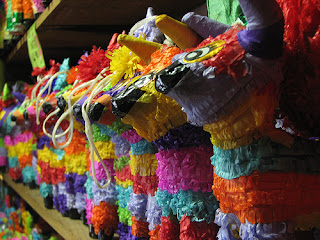
Photo thanks to bodytothesouth, Flickr.com
I hope everyone reading this blog has at one time in their life experienced the joy of striking a pinata open, and enjoying all the goodness it delivers in the form of delicious candies. This blog is dedicated to the wonderful Mexican tradition of the pinata.

As I started doing some research about the origins of the pinata, I couldn't come up with a straight answer. Some say it came from China, others say Italy and some say it came from the Aztecs. What I did find that was agreed upon was that the word "pinata" comes from the Italian word "pignatta," a pine-cone-shaped clay pot.

I also learned another interesting fact. The Mexican people often used the pinata as a religious teaching tool. The ways it was used seem to vary a bit, but here were the most interesting ones I found:
  1. The seven pointed pinata has seven points representing the seven deadly sins (envy, sloth, gluttony, greed, lust, wrath and pride).
  2. Some explain the beautiful colors of the pinata to represent the false beauty of Satan, and the candies inside are the tempations of the world. The stick is then used as to destroy the "evil" represented in the pinata.

  3. In the above scenario, the blindfolded person represents "blind faith." Photo thanks to MaLuMaPe, Flickr.com
  4. Others say the stick represents love, and only love (Jesus) can destroy sin.

  5. In the above scenario, the candies represent the forgiveness of sins, and new life.

Pinatas are generally used at celebrations like Christmas or birthday parties, not merely for religious illustrations. They can be any design or size you want them to be.

If that's the case, why not make your own pinata? It can be a fun family project, and a great activity at any party. Click here for a "how to" Web Site with instructions on how to build your own 6-point pinata. Just add your own extra point if you want to use it for the religious symbolism.

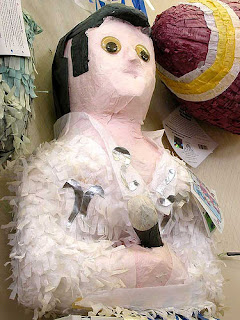
If another design is what you want, try Google.com for "pinata patterns" and browse through the results. I'm sure you'll find something perfect for your special occasion. Here is a photo I found of an Elvis pinata: Photo thanks to chotda, Flickr.com


The possibilities are never-ending!

Sunday, September 23, 2007

Interior Design

Courtesy of Mr. Greenjeans, Flickr.com
Decorating the interior of your home is a process that can be expensive, time consuming and difficult. My husband and I discovered coming up with a color scheme and a "theme" makes the process much easier. I would describe our home as "Mediterranean beachy." This blog, however, is going to provide some tips on how to create a beautiful Mexican themed home, in a simple and frustration-free way.


Step 1: Pick a Color Scheme

Mexican design is known for some bright colors, so don't be afraid to step out of your comfort zone. According to an HGTV article, architect Manolo Mestre says the new trend in Mexican design is to combine a gray base with accents of red and yellow.

How can you do this?

Painting your walls is a great way to add color to your home, BUT, it is also time consuming and expensive. Here are some simpler ways to add color:
  • Pillows - Use red and yellow pillows on a gray couch to get some color in the room.
  • Lamps - Find a table lamp with a red, yellow or green base. To save money, paint an existing lamp one of these colors.
  • Table linens - IKEA carries some great and inexpensive table linens in bright colors that can instantly add color to your dining room. Try a red table runner and red chair pads. If you want to add in some gray, paint your existing table and chairs.
  • One splurge item - Add a huge dash of color by finding one special item that you love, and don't mind spending a little bit of money on. Maybe a beautiful red comfy chair, or a gorgeous orange area rug. One large colorful item can make a huge difference in a room void of color.

Courtesy of J. Ruth, Flickr.com

Step 2: Add Some Tile

One common theme in Mexican design is artistic tile arrangement. An obviously appropriate place to do this would be in your kitchen. Rather than adding tile to the entire wall, which would be expensive and time consuming, displaying a few brightly colored decorative tiles as a backdrop above the oven adds the same feel. If money and time aren't issues, a creative idea is to add decorative tiles in a place that isn't so expected. Here is an image of a creative tile display near a staircase:


Courtesy of Svanes, Flickr.com

Step 3: Silver Frames

Silver frames are a popular Mexican design element. A great way get this look is to do use one large silver framed mirror in the vanity area of the bathroom. If one large mirror is too costly, a little cluster of smaller framed mirrors in the hallway is a nice look. Here is one take on it:


Courtesy of Drew-o-rama, Flickr.com


Step 4: Folk Art


The last major step to a Mexican home makeover is to add some traditional Mexican folk art. Wall art is always acceptable, but Mexican folk art is generally not meant for the walls. Here are some wonderful examples of some art you can add to your coffee table, end tables or any ledge or shelf you have available:


Courtesy of Lorimarsha, Flickr.com and Courtesy of Stribdawn, Flickr.com

These simple steps should get you on your way to a makeover worthy of the "spicy" style of Tucson, AZ.

Monday, September 17, 2007

The Children

*This blog is a supplement to my story "Teacher Helps Immigrant Students Succeed" in the education section of Borderbeat.net.

After interviewing Diane Lopez, a teacher of mostly illegal immigrant children at Apollo Middle School, I had a different outlook on the way I view illegal immigrants, and the way the press is dealing with the entire immigrant situation. Hearing stories of individual children and what they go through everyday really got the wheels turning in my head.

When I turn on talk radio, or watch a cable news station all I hear is banter back and forth between liberals and conservatives and how they intend to solve this illegal immigrant problem. Most of the issues they discuss are about health care and the economy.

I understand both sides of the argument, and the frustrations people are feeling regarding this issue. My frustration is that we keep dealing with illegal immigration as if every person that comes over the border illegally has the exact same background, the exact same intentions and the exact same problems.

Just like we are discovering in Iraq right now, it is extremely difficult to deal with a large group of people and bring about change, because not all people are going to respond the same way. Some Iraqi's are welcoming to change, and some are not. We see the two different responses covered in the media; the conservative media covering the former angle, and the liberal media covering the ladder.

I don't like to group myself with liberals or conservatives because I don't fully agree with either side on any issue. But, what I would like to see the mainstream media do regarding the issue of illegal immigration is to STOP the banter, and start looking at individuals.

There are reasons why thousands of illegal immigrants are "sucking our health care system dry," as I heard a caller say on a local radio program today. Now, I myself am in the middle of a health insurance bind, so I understand completely why some Americans are tired of seeing illegal immigrants use up government health care money from programs such as ACCHHS. But I hate that so many Americans are looking at these people like they're leeches.

Particularly in the case of children. Mainstream media personalities argue back and forth about this issue, treating the entire immigrant populous like chattel. If only they would realize that not everyone in the world is an American, or thinks like an American. If only they would realize that journalists are not bestowed with superior knowledge that allows them to solve the world's problems, and chide anyone who would dare to disagree. Maybe they could think about their children, and the love and care they are offering them by making a living, and then think about these immigrant children who are completely innocent of what their parents are having them do.

Illegal immigration is still illegal, and I'm not arguing that it's OK, but can someone please just get over themselves long enough to shut their bantering mouths up, and see some people instead of numbers? Let me introduce you to the children...